Coalescence-based Bedside Diagnostic Tool for Nucleic Acid Detection
In July and August 2018, I was involved in a startup from the Marileen Dogterom lab (Delft University of Technology). Our goal was to create a cheap bedside diagnostic tool, where the turbidity of a fluid indicated whether a certain pathogen was present. Our technique did not recquire laboratory equipment and could be interpreted by non-professional users.
Coalescence-based Readout
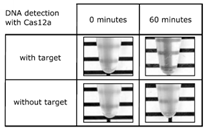
The diagnostic tool took shape of a small laboratory tube, like an Eppendorf. The readout was based on solution turbidity. Transparent meant positive, turbid meant negative. The test took approximately one hour to settle.
Liquid-Liquid Phase Separation
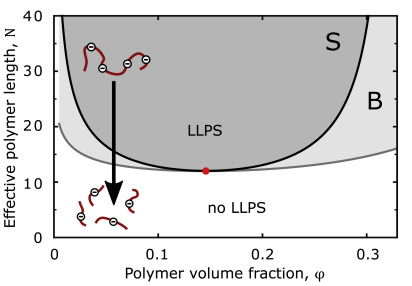
In polymer solutions, a thermodynamically-driven phenomenon can occur where a homogeneous solution spontaneously de-mixes into two phases. This effect is called liquid-liquid phase separation (LLPS). When it occurs, polymers form droplets called coacervates that are surrounded by a solvent. LLPS occurs because the required energy for mixing the polymers outranks the entropic gain of that mixing. For larger polymers, LLPS occurs more readily.
Cpf1 and C2c2
One of the CRISPR/Cas complexes is called Cpf1 (or Cas12a), which is an RNA-guided DNA endonuclease. After binding to its target, it begins cleaving DNA molecules nonspecifically. C2c2 (or Cas13a) is a comparable endonuclease, but it cleaves RNA. It also has the collateral cleavage property, just like Cpf1.
Detection of Nucleic Acids
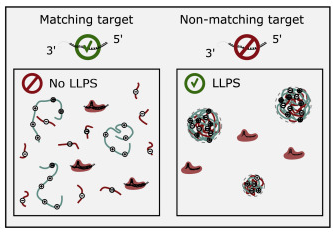
Our diagnostic test contained a solution with large DNA molecules and Cpf1 loaded with guide RNA that refers to a pathogen. By LLPS, the large molecules spontaneously de-mix into coacervates, making the fluid turbid. In the presence of pathogen DNA, Cpf1 binds to the target and turns into a nonspecific DNase, collaterally cleaving the large DNA molecules. This undoes the LLPS. Therefore, the fluid becomes transparent, indicating that pathogen DNA was present.
Want to learn more?
Please, feel free to contact me for questions. The article explaining the technique can be found here.
Terug naar Biotech